Sep 11, 2026Buying Guides
How to Choose Carbon Bike Frame: Size, Geometry & Material Tips
Wondering how to choose a carbon bike frame? Learn essential tips for proper frame sizing, terrain-matched geometry, reliable carbon materials, and key quality details for road, MTB, and gravel bikes.
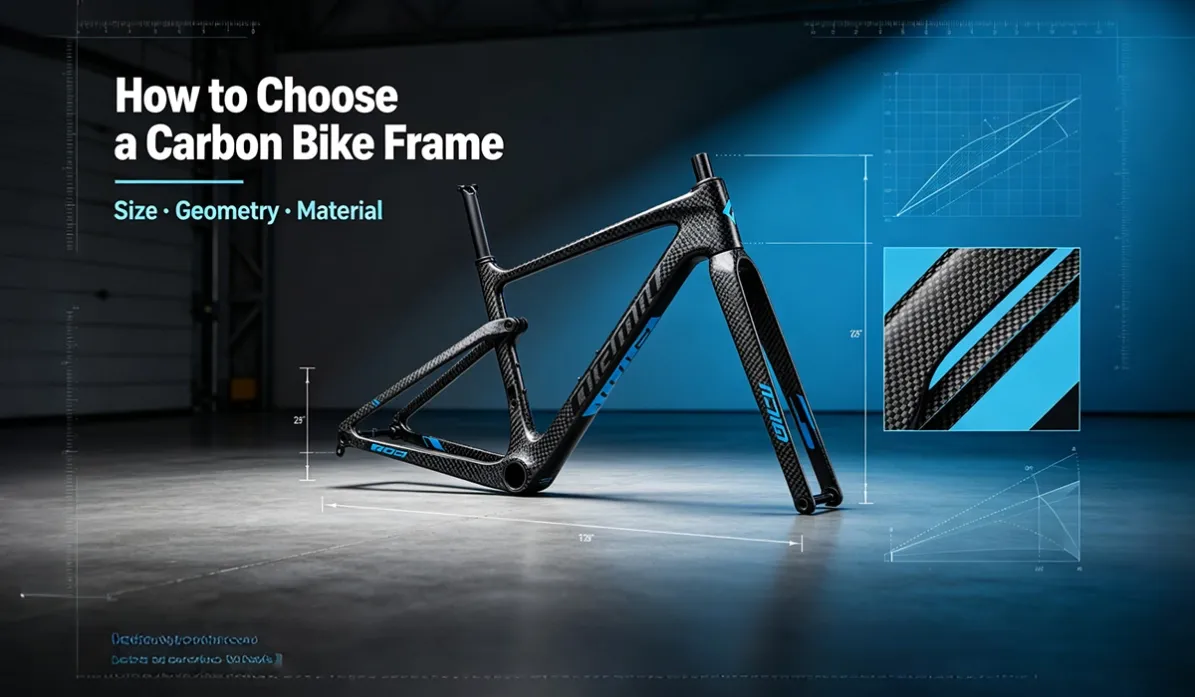
A carbon bike frame is the core structural foundation for professional bicycle manufacturing, wholesale, and OEM customization. It directly determines overall product performance, riding stability, durability, and market competitiveness. Compared with aluminum and steel frames, carbon fiber frames offer superior lightweight performance, higher rigidity, and better vibration reduction. For bicycle brands, bulk buyers, and factory partners, selecting qualified carbon frames based on standardized sizing, geometric design, and material craftsmanship is critical for stable batch quality and low after-sales rates.
1. Choose the Right Frame Size for Target Market Positioning
Standardized frame sizing is the basic principle for mass procurement and carbon frame customization. Unsuitable frame sizes will cause uncomfortable riding postures, inefficient power output, and negative user feedback, which greatly affect product reputation and resale value.
Road carbon frames typically adopt 48cm–62cm standard sizing systems, while MTB and gravel frames commonly use S/M/L/XL grading. Professional size development is based on target user height, inseam data, and regional market habits. Reasonable size grading allows brands to cover different consumer groups and achieve better market adaptability.
For cross-country MTB and long-distance gravel product lines, slightly compact frame sizes deliver more flexible handling and stronger terrain compatibility. For road racing and endurance road bike projects, standard or slightly larger frame sizes provide optimized power transmission and aerodynamic advantages, suitable for high-end market positioning.
2. Match Frame Geometry with Product Line Positioning
Frame geometry determines a bicycle’s riding posture, stability, and terrain adaptability. Different bike categories require dedicated geometric tuning, which is a key technical reference for B2B sourcing and product development.
Road bike carbon frames feature steep head tube angles, short wheelbase, and low stack height. This geometry creates an aerodynamic, forward-leaning riding position, minimizing wind resistance and improving sprinting and climbing performance. It is ideal for professional racing and high-speed road product series.
MTB carbon frames focus on structural stability and impact resistance. With slacker head tube angles, longer wheelbase, and higher standover height, these frames ensure stable control on rugged off-road terrain, effectively reducing frame impact risks and improving product durability for mountain bike series.
Gravel carbon frames adopt balanced and versatile geometry. Optimized tire clearance, moderate head tube angle, and user-friendly stack & reach data enable strong adaptability for paved roads, gravel roads, and forest trails. This multi-scenario performance makes gravel carbon frames highly competitive for all-terrain bicycle product lines.
3. Understand Carbon Grade & Industrial Layup Standards
Carbon frame performance varies greatly depending on carbon fiber grade, resin formula, and industrial layup process. These manufacturing standards directly affect batch consistency, structural rigidity, shock resistance, and long-term fatigue resistance — key indicators for B2B quality evaluation.
Mass-production carbon frames generally adopt T700, T800, and T1000 carbon fiber materials. T700 carbon delivers balanced cost performance, excellent toughness, and stable pressure resistance, ideal for entry and mid-level wholesale projects. T800 and T1000 high-grade carbon provides lighter weight and higher stiffness, offering more sensitive power transmission, perfect for high-end OEM and premium bicycle product lines.
Beyond carbon grade, standardized layup technology is essential for batch quality control. Scientific fiber arrangement and uniform resin distribution ensure lightweight design without sacrificing structural strength. Reliable manufacturers adopt localized reinforcement at key stress points including head tube, bottom bracket, and seat tube, greatly improving impact resistance and torsional stability for long-term mass-market use.
4. Verify Structural Details & Cross-Part Compatibility
For bulk procurement and OEM projects, frame compatibility and structural standardization directly reduce assembly costs and after-sales problems. Tire clearance is a key parameter: MTB and gravel frames require larger clearance for wide off-road tires, while road frames focus on aerodynamic tire matching for speed-oriented product positioning.
Meanwhile, unified interface standards — including bottom bracket specifications, brake mounting positions, and derailleur port layout — ensure high compatibility with mainstream bicycle components. Standardized internal cable routing and durable surface finishing also improve product appearance, corrosion resistance, and market grade, simplifying mass assembly and aftermarket maintenance.
5. Focus on Industrial Craftsmanship & Systematic Quality Testing
Stable B2B supply relies on mature manufacturing processes and complete quality control systems. Qualified carbon frame factories conduct systematic tests including impact resistance, load capacity, torsion stability, and high-low temperature fatigue testing. Full inspection procedures eliminate hidden structural defects and ensure consistent batch quality.
Low-cost untested carbon frames often contain hidden issues such as internal bubbles, uneven layup, and incomplete resin curing, which bring huge safety risks and high return rates. Formal production standards and complete quality certification are the core guarantees for long-term brand cooperation and stable product delivery.
Final Thoughts
Sourcing high-quality carbon bike frames is not about blind pursuit of extreme configurations, but reasonable matching of size systems, geometric positioning, material grades, and manufacturing quality according to your product line and market demand. Well-selected carbon frames help bicycle brands and wholesalers improve product competitiveness, reduce after-sales risks, and build stable long-term product systems for road, mountain, and gravel bike markets.